On 14 May 2025, representatives of the Centre for Research and Analysis (CRA) took part in the opening of a new STEM centre at the Vocational High School of Food Technologies and Engineering in Plovdiv. The centre focuses on green technologies and sustainable development and was established within the framework of Bulgaria’s National Recovery and Resilience Plan, co-financed by the European Union. A significant part of the equipment features original designs by Eng. Krasimir Georgiev and Todor Georgiev from “WebServices”, a company with well-established traditions and extensive experience in developing STEM centres in Bulgaria.
“In today’s global context, we all see how critically dependent we are on traditional fuels. This is why education in renewable energy sources is of crucial importance. Today, our students will master new technologies in order to use natural resources wisely and with a vision for the future,” said the school principal, Eng. Lyudmila Gancheva, at the ribbon-cutting ceremony.
Assoc. Prof. Dr. Todor Yalamov presented the importance of microelectronics for the development of a competitive economy through the lens of the European project Chips for Europe, and invited students and teachers from the “Heat Engineering” specialization to visit the Discoverer supercomputer at Sofia Tech Park. In 2021, it was among the world’s most powerful supercomputers, ranked 91st globally and 66th in the HPCG (High-Performance Conjugate Gradient) ranking.
The cooling of chips, data centres, and supercomputers is a highly advanced and complex process requiring different engineering competencies compared to those involved in chip design and manufacturing. A systemic approach to building an innovation ecosystem for the microelectronics and semiconductor industry requires the integration of diverse specialised expertise.
The future of so-called “space chips” is also linked to the capabilities of companies such as “Liebherr” (with production facilities in Plovdiv), which develop specialised evaporators and condensers for thermal dissipation control in zero-gravity conditions for next-generation satellites.
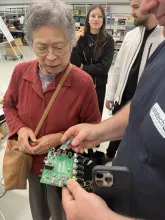
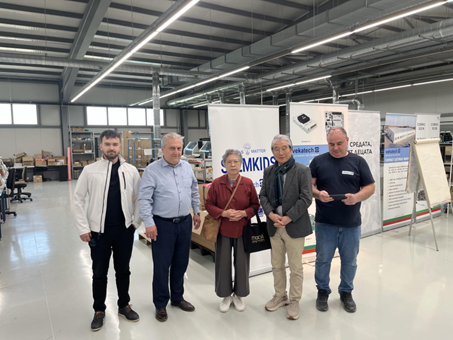
The visit of the Centre for Research and Analysis also included a tour of the production facilities of “Vekatech”. Mr. Teodor Vendov welcomed guests from Japan – Prof. Hiroo Takahashi and his wife Ms. Michiko Takahashi, as well as the students Deyan Yalamov and Michaela Minkova. “Vekatech” is a well-established EMS (Electronic Manufacturing Services) manufacturer working primarily with Japanese technologies.
Mr. Vendov also participated in the opening of the STEM centre at the Vocational High School of Food Technologies and Engineering in Plovdiv, where together with Assoc. Prof. Dr. Todor Yalamov they discussed opportunities to expand STEMKids activities with students and teachers from the school. Among the topics discussed was also the idea of a future nationwide teacher training programme in partnership between “Vekatech” and the Centre for Research and Analysis, which could serve as a foundation for a national competition in the field of microelectronics and semiconductor technologies.
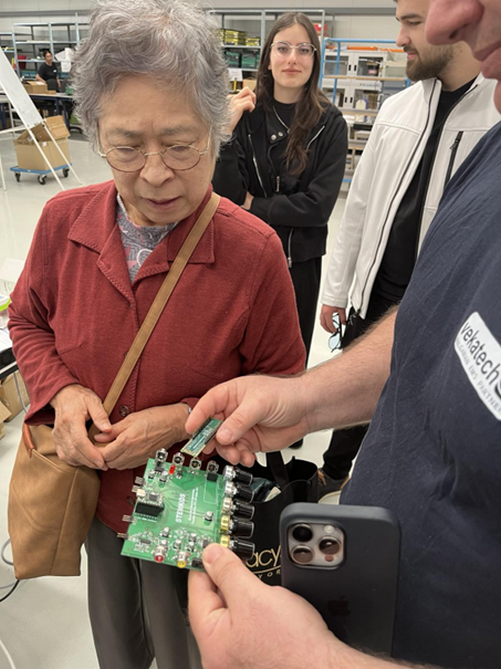
A specialised circuit board designed with the participation of children from STEMKids
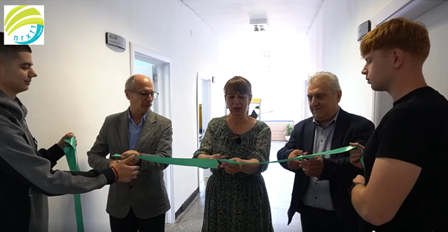
Left to right: Assoc. Prof. Dr. Borislav Milenkov, Eng. Lyudmila Gancheva, Assoc. Prof. Dr. Todor Yalamov
STEM center, Plovdiv